Frequently Asked Questions About Family Violence by Jeremy Harrow
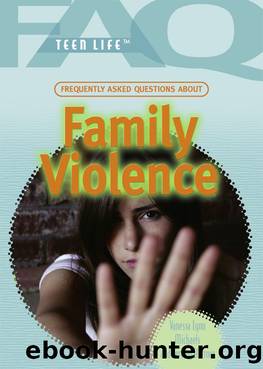
Author:Jeremy Harrow
Language: eng
Format: epub
Publisher: The Rosen Publishing Group, Inc
If someone hits you, itâs important to have someone document your injuries in case you decide to press charges. See a doctor as soon as possible.
Domestic violence does not go away on its own. You will have to take action if you want the abuse to stop. Remember, domestic violence is a crime, and you do not have to tolerate it. You have the right to live a healthy, successful life.
Report Your Parents
Everyone looks to his or her parents for love and attention. It is a natural reaction to have mixed feelings about your abusive parent. You might feel sorry for your mother and want to help her because she was abused as a child. At the same time, you might feel angry that she continues to abuse you just as she was abused. Maybe you are waiting for the love and attention she gives to you during the good times. Or maybe you are afraid that if your mother is taken away, your father will be alone.
In most states, the goal of the legal system is to protect the abused, not to punish the abusive parent. In some cases, the social worker will try to get help for your parent through counseling and/or support groups. In those cases where the danger is more serious or life-threatening, the courts will take the necessary action to keep you safe and punish the abuser.
If you are being physically or sexually abused by one of your parents, your rights as a minor (a person under the age of eighteen) are complicated. In most states when you tell any adultâa school official, a doctor, a nurse, a therapist, a police officer, or a domestic violence advocateâthat you are being abused, he or she is considered a mandated reporter. He or she is required by law to report the abuse to the child protective services in your area. The child protective agency will open an investigation once the abuse has been reported. You will be interviewed, as will your parents and anyone else involved in the situation. During the investigation, the child protective agency may decide that it is necessary that you live outside the home. This is for your own safety. You will be asked to stay with a trusted adult or a family member. Although all of this will be difficult, it is a necessary process to end the abuse.
Alternatives to Filing a Report
If you do not want to report your abuse, you can call a domestic violence agency and ask for help anonymously. Most advocates will answer your questions even if you do not want to give your name. Being underage means that you probably donât have enough money to survive on your own. But you may know a trusted adult with whom you would be willing to live until your home feels safe again or until you can start your own life.
You Can Help a Parent
If one of your family members, such as a parent, is being abused, you need to help your loved one by being supportive and helping him or her get out of the situation.
Download
This site does not store any files on its server. We only index and link to content provided by other sites. Please contact the content providers to delete copyright contents if any and email us, we'll remove relevant links or contents immediately.
Call me by your name by Andre Aciman(4671)
Rowling, J.K - Harry Potter 02 - Harry Potter and the Chamber of Secrets by Rowling J K(3305)
Paardenranch heartland - vol vertrouwen by Lauren Brooke(3148)
Harry Potter and the Chamber of Secrets (Book 2) by J.K. Rowling(2807)
The Kiss of Deception by Mary E. Pearson(2777)
Day by Elie Wiesel(2775)
Harry Potter and the Goblet of Fire (Book 4) by J.K. Rowling(2748)
A Thousand Splendid Suns by Khaled Hosseini(2686)
Holes by Louis Sachar(2665)
Just Listen by Sarah Dessen(2572)
How to Make a Wish by Ashley Herring Blake(2567)
I've Got Your Number by Sophie Kinsella(2530)
Bossypants by Tina Fey(2514)
Holding Up the Universe by Jennifer Niven(2491)
Talking as Fast as I Can by Lauren Graham(2428)
Confessions of a Shopaholic by Sophie Kinsella(2337)
Call Me by Your Name: A Novel by André Aciman(2198)
The Body Keeps the Score by Bessel van der Kolk MD(2190)
No Time to Say Goodbye(2108)
